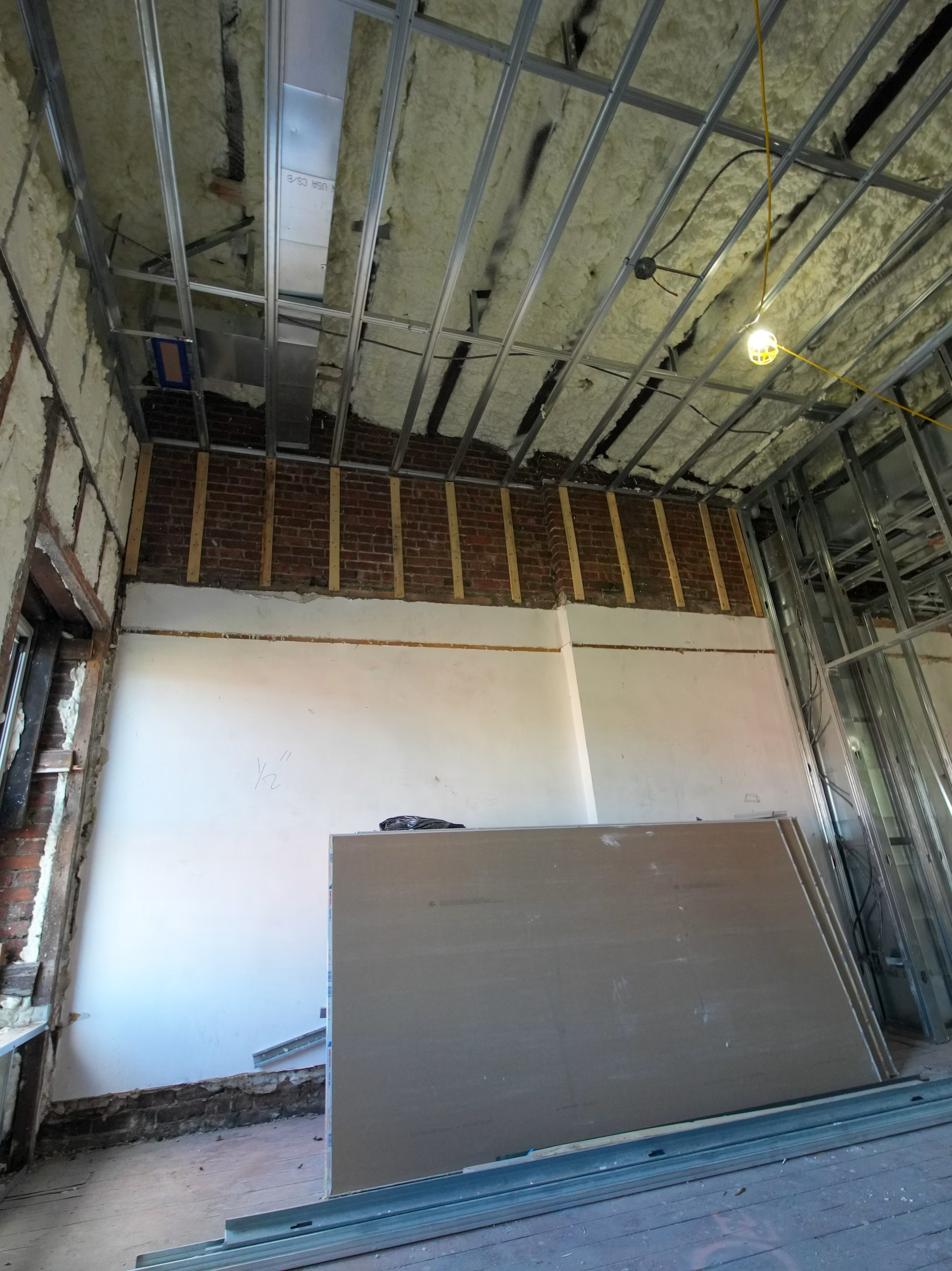
If you’re pricing insulation in the Fargo-Moorhead area, the first number you’ll notice is that fiberglass costs less per square foot than spray foam. That’s true, and if the two materials did the same job, the decision would be easy. But in a climate like ours, they don’t do the same job — and the difference shows up on your heating bill every winter for as long as you own the house.
Short version: Fiberglass slows heat but does nothing to stop air moving through your walls and attic. Spray foam does both — it insulates and air-seals in one step. In Fargo’s Climate Zone 7, where we see -20°F stretches and hard prairie wind, air leakage is a huge share of a home’s heat loss, so the air-sealing matters as much as the R-value. Fiberglass wins on upfront cost; spray foam wins on performance, longevity, and total cost over the life of the home — especially here.
The number on the bag isn’t the whole story
Both materials are sold by R-value, and on paper a thick fiberglass batt looks competitive. The catch is that fiberglass R-values are measured in lab conditions: no wind, no air movement, batt perfectly fitted. Real walls in Cass and Clay County houses aren’t lab conditions.
Fiberglass is essentially an air filter — it slows air, it doesn’t stop it. When a January wind comes across the Red River Valley (and there’s not much between here and the horizon to slow it down), it pushes cold air through gaps, around outlets, and straight through the batt itself. Cold air washing through fiberglass can cut its effective R-value dramatically, right when you need it most. Fiberglass also loses performance as temperatures drop and can settle or sag over decades, opening gaps at the top of wall cavities.
Closed-cell spray foam delivers roughly R-6 to R-7 per inch — about double fiberglass — and because it expands to fill the cavity and cures rigid, its rated performance is what you actually get, at -20°F as much as at 40°F.
Air-sealing: the part fiberglass can’t do
Air leakage is one of the biggest sources of heat loss in a typical home, and it’s brutal here for two reasons. First, the stack effect: the bigger the temperature difference between inside and out, the harder warm air pushes up and out through the attic while cold air gets pulled in low. A 90-degree difference — 70°F inside, -20°F outside — is an ordinary Fargo cold snap, and it turns every gap in the envelope into a chimney. Second, the wind: flat, open terrain means sustained pressure on the windward side of the house all winter.
Spray foam seals the rim joists, top plates, penetrations, and cavity edges as it insulates. That’s why homes that switch from leaky fiberglass to a foam-sealed envelope routinely see heating savings in the 15–30% range — the savings come from stopped air leaks as much as from added R-value. It’s also the mechanism behind ice dams: warm air leaking into the attic through fiberglass melts roof snow unevenly. Attic spray foam stops that at the source.
Moisture — the quiet failure mode in ND walls
There’s a moisture angle, too. Warm indoor air holds moisture, and when it leaks into a wall cavity and hits a cold sheathing surface in a Zone 7 winter, it condenses. Damp fiberglass loses insulating value and can feed mold and rot from inside the wall, invisibly. Closed-cell foam acts as its own vapor retarder and doesn’t absorb water, which is a big part of why it’s the go-to for basements, rim joists, and exterior walls in North Dakota homes.
Where fiberglass still makes sense
We’re not going to tell you fiberglass is useless — it isn’t. For interior partition walls, sound control between floors, or a tight budget on a space that’s already well air-sealed, it’s a reasonable material. A common hybrid approach in homes around West Fargo and the wider Fargo-Moorhead area is “flash and batt”: a couple inches of closed-cell foam against the sheathing for the air seal and vapor control, with fiberglass filling the rest of the cavity to hit the R-value target at lower cost.
The math over time
Fiberglass is cheaper on day one. But it typically underperforms its rating in cold, windy, real-world conditions, may need topping up or replacing over the decades, and leaves the air-sealing job undone. Spray foam costs more upfront, performs at its rating for the life of the building — 80+ years without sagging or settling — and cuts the heating load in the coldest months, which is where most of a Fargo home’s energy budget goes. Over a 10–15 year horizon, the total cost of ownership usually favors foam, and every winter past that is gravy.
Weighing the two for your project? Request a free quote or call us. We’ll look at your walls, attic, and budget, tell you honestly where foam earns its cost and where a hybrid approach makes sense, and give you numbers for both — no pressure either way.