Every Fargo winter, you see them: thick ridges of ice along the eaves, icicles hanging off the gutters, and meltwater backing up under the shingles. They can look almost decorative, but an ice dam is a roof problem in slow motion — and the real fix isn’t on the roof at all. It’s in your attic.
Short version: Ice dams form when heat leaking into your attic melts the snow on your roof, the meltwater runs down to the cold eaves, and it refreezes into a dam that traps more water behind it. The water then backs up under your shingles and leaks into the house. Air-sealing and insulating the attic keeps the roof deck cold and uniform, so the snow never melts unevenly in the first place. In Fargo’s climate, spray foam is the most reliable way to stop both the air leaks and the heat loss that cause ice dams.
Why ice dams happen — the heat-leak chain
An ice dam needs three ingredients, and the Red River Valley supplies all of them generously: snow on the roof, a roof surface that’s warm in the middle and cold at the edges, and outdoor temperatures below freezing. We have snow on the roof for months, and Fargo sits in IECC Climate Zone 7 — among the coldest zones in the lower 48 — so the freeze part is never in short supply.
The variable you can actually control is that warm-in-the-middle, cold-at-the-edges roof. It happens when heat escapes from your living space into the attic. That warm air heats the underside of the roof deck over the main part of the house, melting the bottom layer of snow. The meltwater trickles down to the eaves and the roof overhang — which hang out over open air and stay at outdoor temperature — and there it refreezes. Repeat that cycle for a few cold days and you get a growing wall of ice that ponds water behind it. Water has nowhere to go but sideways and up, under the shingles, and eventually through the ceiling.
Why Fargo attics leak heat
Most ice-dam trouble in older Fargo and Moorhead homes traces back to two things: air leaks and thin or settled insulation. Recessed lights, the attic hatch, bathroom fans, plumbing stacks, and the top plates of interior walls are all little chimneys that let warm, moist house air rise straight into the attic. On top of that, a lot of homes were built with a modest layer of blown fiberglass that has settled and compressed over the decades, leaving an R-value well short of what Zone 7 calls for.
Adding more loose-fill on top of leaky framing doesn’t solve it, because fiberglass slows heat but does nothing to stop air movement. The warm air keeps leaking through, and now it’s carrying moisture into a colder attic — which can mean frost on the underside of the roof deck and damp insulation. You’ve added R-value on paper and still have ice dams.
How spray foam stops the cycle
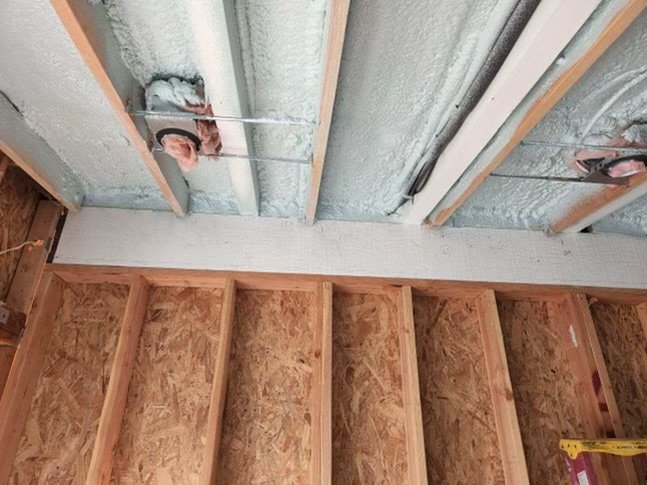
The fix is to break the heat-leak chain at its source. Spray foam attic insulation air-seals and insulates in one step:
- It seals all those gaps and penetrations, so warm house air stops rising into the attic.
- It insulates at a high R-value, keeping heat in your living space where you’re paying to put it.
- Together, that keeps the roof deck cold and uniform — so snow melts evenly off the roof (or not at all) instead of running down to refreeze at the eaves.
Depending on the home, that can mean sealing and insulating the attic floor, or — for finished attics, bonus rooms, and homes with HVAC up there — spraying the underside of the roof deck to bring the whole attic inside the conditioned envelope. We’ll look at how your attic is built and recommend the approach that fits. The same air-sealing work that stops ice dams also cuts your heating bills and gets rid of those cold upstairs rooms, so it tends to pay for itself on more than one front.
Signs your attic is the problem
- Icicles and ice ridges along the eaves and gutters every winter.
- Water stains on upstairs ceilings or near exterior walls after a thaw.
- Upstairs rooms that are colder than the rest of the house.
- Uneven snowmelt — bare patches over the heated part of the roof while the eaves stay packed with ice.
- Frost or damp insulation visible in the attic.
These show up across the metro, from older neighborhoods near downtown Fargo to homes in West Fargo and Moorhead. If you’re seeing them, the roof is telling you about your attic.
Tired of chipping ice off your gutters every February? Request a free quote or give us a call. We’ll get up in your attic, find where the heat and air are escaping, and give you a clear, no-pressure plan to stop the ice dams at the source.