Ask around Fargo-Moorhead about topping up an attic and you’ll hear the same advice: “just blow in cellulose, it’s cheap.” For a lot of houses, that’s not wrong. But it’s incomplete — and in Climate Zone 7, the part it leaves out is the part that causes ice dams, frosty attic hatches, and heating bills that never quite come down.
Short version: Blown-in cellulose is the cheaper way to add R-value to a vented attic floor, and it works well if the attic floor is air-sealed first. Spray foam costs more but insulates and air-seals in one step, and it’s the only practical choice if you want an unvented (conditioned) attic. In Fargo’s climate, air leakage into the attic — not thin insulation — is what drives ice dams and frost, so the right answer depends on how leaky your ceiling is, not just the R-number.
Two materials doing two different jobs
Cellulose is loose, treated paper fiber blown over your attic floor. It’s good at one thing: adding R-value cheaply, around R-3.2 to R-3.7 per inch. Pile up 16–20 inches and you can hit the R-49+ that Zone 7 calls for without breaking the bank.
What cellulose can’t do is stop air. Every top plate, wire penetration, bath-fan housing, recessed light, and the chimney chase in your ceiling keeps leaking warm, moist house air into the attic right through the fluff. In a Fargo January, with a 90-degree difference between your living room and the attic, the stack effect pushes hard on every one of those gaps — that’s the mechanism behind ice dams on Fargo roofs and the frost you see on nails and sheathing in February.
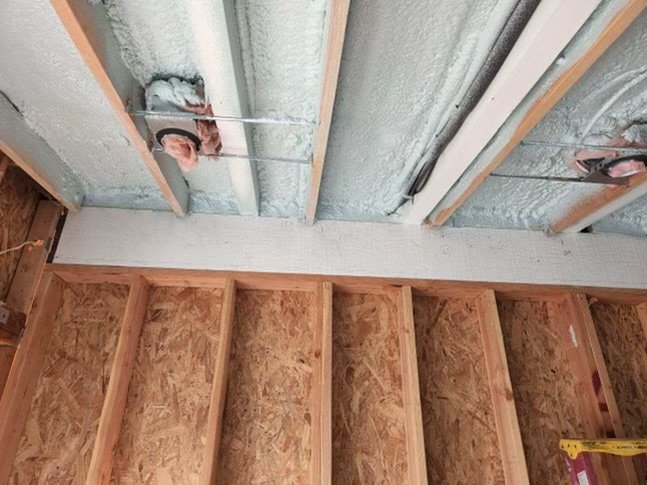
Spray foam does both jobs at once. Closed-cell foam at the roof deck or floor delivers R-6 to R-7 per inch and seals the leaks as it goes. That’s the whole argument in one sentence: cellulose adds R-value; foam adds R-value and closes the chimney.
When blown-in cellulose is the right call
We install spray foam for a living and we’ll still tell you: for a simple, vented attic with decent access, few penetrations, and a ceiling that’s already tight (or can be air-sealed with a few hours of foam-gun work first), blown-in cellulose over the floor is honest value. Common in newer ranches around Horace and West Fargo where the ceiling plane is simple and the bath fans are ducted properly.
The best-of-both approach — and one we do often — is a hybrid: spray foam the attic floor’s problem spots (top plates, penetrations, dropped soffits, the hatch) to create the air barrier, then blow cellulose over it for cheap R-value. You get most of the foam benefit at a fraction of full-foam cost.
When spray foam wins outright
Some attics shouldn’t get loose fill at all:
- Older homes with complicated ceilings. The 1920s–1960s housing stock in Fargo and Moorhead is full of dropped soffits, knee walls, balloon-framed chases, and plaster ceilings with dozens of hidden bypasses. Blowing cellulose over those leaks buries the problem; it doesn’t fix it.
- You want the attic inside the envelope. Ductwork or HVAC in the attic, a bonus room, storage you actually use — foam at the roof deck brings the whole space into conditioned air. Cellulose can’t do an unvented assembly; in Zone 7 that’s closed-cell territory so the sheathing stays warm and dry.
- Recurring ice dams. If you’ve already had dams and the interior water stains to prove it, the fix is stopping air leakage, not adding fluff. Foam is the direct fix.
- Moisture history. Cellulose absorbs water; a small roof leak or heavy frost event can leave it matted and underperforming. Closed-cell foam doesn’t absorb water — same reason it’s the pick for rim joists in Fargo basements.
The math for a Fargo attic
Cellulose top-up is typically the cheapest per R. Full closed-cell at the roof deck costs several times more upfront — but it also does the air-sealing job, protects the sheathing, and performs at its rating through -20°F cold snaps for the life of the house. If your attic is simple and tight, take the cellulose savings. If it’s leaky, complicated, or you’ve fought ice dams, cheap insulation over a leaky ceiling is money spent on the wrong problem. (Same logic as the spray foam vs. fiberglass comparison: the air-sealing is half the value.)
Not sure which attic you have? Request a free quote and we’ll look — if a foam-and-cellulose hybrid or even a straight cellulose top-up is the smarter spend for your house, we’ll say so.