If your furnace runs all January and the back bedroom is still cold, the problem usually isn’t the furnace — it’s the air leaking out of the house faster than you can heat it. In a Fargo winter, where it’s routinely below zero for weeks, every gap in the building shell is a hole you’re paying to heat. The good news: those leaks are findable, and most of them are fixable in a day.
Short version: As much as 40% of a building’s energy is lost to air infiltration — air sneaking in and out through gaps you can’t see. About half of a home’s energy goes to heating and cooling (EPA), so plugging those leaks is the single biggest lever on a Fargo heating bill. Spray foam works as both insulation and an air barrier, which is why air-sealing the attic, rim joists, and trouble spots can trim heating costs meaningfully and let a smaller furnace do the same job. Start with the attic and rim joist — that’s where Red River Valley homes leak the most.
Why air leaks cost so much in a Zone 7 winter
Fargo sits in Climate Zone 7, one of the coldest in the country. The bigger the temperature gap between inside and outside, the harder air gets pushed through every crack — it’s called the stack effect: warm air rises and escapes high in the house, which pulls cold air in low. On a –20°F night with the wind howling out of the northwest, that engine runs hard. A leaky house doesn’t just feel drafty; it forces the furnace to reheat a constant stream of cold replacement air.
Fiberglass batts slow heat transfer but do almost nothing to stop air movement. Spray foam does both at once — it fills the cavity and seals it — which is why air-sealing is the highest-return insulation work you can do in our climate.
The spots a Fargo house actually leaks
If you could see air the way an infrared camera does, here’s where you’d watch the heat pour out of a typical Fargo-Moorhead home, roughly worst-first:
- The attic plane. Warm air collects at the top of the house and escapes through attic hatches, recessed lights, plumbing vents, and the framed chases around the furnace flue and ductwork. Air-sealing the attic floor before adding insulation is the move — see How Attic Air-Sealing Stops Ice Dams on Fargo Roofs. Attic insulation is almost always the first dollar best spent.
- The rim joist (band joist). That ring of framing where the foundation meets the floor is a notorious leak point in our basements — thin, uninsulated, and exposed to the cold on three sides. We dug into it in Why Fargo Basements Lose So Much Heat at the Rim Joist.
- Behind knee walls in story-and-a-half and Cape Cod homes — common in older Fargo and Moorhead neighborhoods — where the short attic spaces behind upstairs walls are often open to the eaves.
- Wiring and plumbing holes, open soffits, and dropped ceilings over kitchens and bathrooms.
- Around windows and doors, especially the gaps hidden behind trim that were never properly sealed when the house was built.
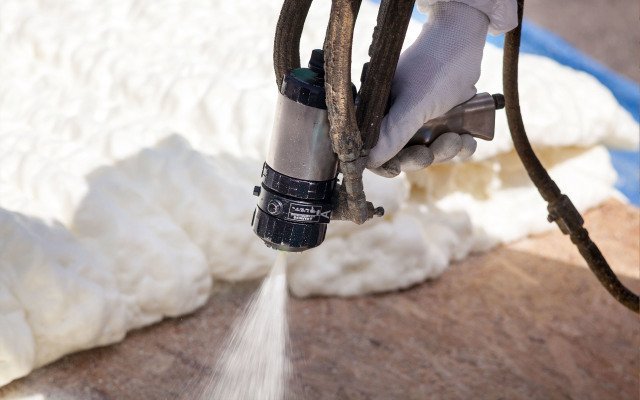
Spray foam is uniquely good at these because it’s applied as a liquid that expands and conforms — it gets into the irregular gaps that batts and caulk can’t reach, and seals wall cavities, crawl spaces, attics, and the small cracks throughout the house in one pass.
The bonus most people miss: a smaller furnace
Here’s the part that surprises homeowners. Once a house is genuinely air-sealed, it needs far less heating capacity to stay warm — industry figures put the potential HVAC downsizing at up to 35%. For new construction in Fargo-Moorhead, that means you can spec a smaller, cheaper furnace that runs longer, steadier cycles instead of an oversized one that blasts and short-cycles. (If you’re building, tell your mechanical contractor about the spray foam before they size the system — more on that in Spray Foam for New Construction in Fargo-Moorhead.)
For existing homes, the payoff shows up as a furnace that doesn’t run flat-out all winter, fewer cold rooms, and a more even temperature from the basement to the upstairs bedrooms.
A practical order of attack for a Fargo home
You don’t have to do everything at once. The highest-return sequence for most Red River Valley houses:
- Air-seal and insulate the attic — biggest, cheapest win.
- Seal and insulate the rim joist in the basement.
- Address knee walls, chases, and any obvious gaps around penetrations.
- Walls — usually a retrofit or new-construction project, covered under wall insulation.
Each step stands on its own, and each one chips away at that 40% you’re currently paying to heat and then lose.
See where your home is leaking
If you’re tired of a furnace that never quits and rooms that never warm up, the fastest way to find the leaks is to have someone who does this every day walk the house with you. Whether you’re in Fargo, West Fargo, Horace, or across the river in Moorhead, request a free quote and we’ll pinpoint where your heating dollars are escaping — and lay out the spray foam plan to stop it before next winter.