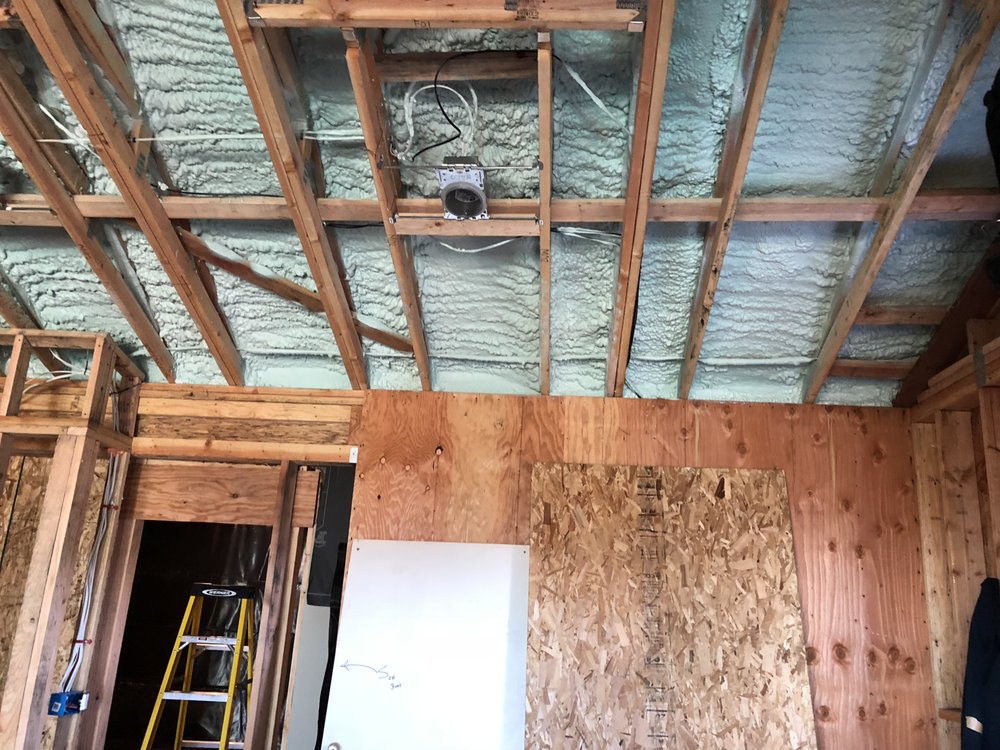
It comes up on almost every attic estimate: the homeowner knows the roof has a slow drip around a vent boot or a stain near the chimney, and asks whether the foam will just seal it up. It’s a reasonable hope — spray foam is waterproof-ish, right? But this is one place where the order of operations really matters.
Short version: Fix the leak first, every time. Spray foam is not a roof repair — foaming over an active leak traps water against the sheathing, hides the drip that would have warned you, and in a freeze-thaw climate like Fargo’s can quietly rot the roof deck for years before anyone notices. A reputable installer inspects for moisture before spraying and will walk away from a wet deck. Roof dry, then foam.
Why foam over a leak goes wrong in Zone 7
In a traditional vented attic, a small roof leak announces itself — you see the stain on the ceiling, or you spot wet insulation when you stick your head up there. The airflow also gives incidental water a chance to dry out between rains. Annoying, but visible and often survivable.
Foam changes both of those things. Once closed-cell foam is bonded to the underside of the roof deck, water coming through a shingle failure has nowhere to go and nowhere to show. It sits between the shingles and the foam, soaking into the sheathing on the one face you can no longer see. And Fargo’s climate makes it worse: our roofs cycle through brutal freeze-thaw swings and carry snow for four or five months, so a small entry point gets worked open a little more every winter while the trapped moisture keeps the wood wet. By the time an unexplained soft spot or a musty smell gives it away, you’re often looking at sheathing replacement — which now also means cutting out and re-spraying foam.
Open-cell foam fails differently but just as surely: it’s a sponge. Forum threads are full of the same caution our industry gives in person — low-density foam that gets saturated holds water against the wood and loses insulating value until it dries, if it dries. Either way, the foam didn’t fix the leak; it hid it.
Water from below counts too
Roof leaks aren’t the only moisture that has to be sorted first. Attic frost from air leaks, a bath fan venting into the attic instead of outside, or a humidifier running hard all winter can load an attic with water vapor from the house side. Spray foam actually helps with those — the air seal is the cure for the leaks behind ice dams and attic frost — but the attic needs to be dry on spray day, and anything actively dumping moisture up there (that bath fan) gets rerouted first. How foam and moisture interact in our climate is its own topic; we covered the vapor-barrier side in spray foam, moisture, and vapor barriers in North Dakota homes.
What a good installer checks before spraying
Before any attic insulation job in the metro, the pre-spray walkthrough should include:
- Visual sheathing inspection — staining, dark rings around penetrations, rust on nail tips (a classic frost tell in Fargo attics), daylight where there shouldn’t be any.
- Moisture-meter readings on any suspect wood. Foam should only go onto a dry deck; wet lumber also keeps foam from adhering properly.
- Roof age and condition question — if the shingles are at end-of-life, it’s worth re-roofing before creating an unvented assembly, since the next roofing job is simpler and cheaper with a sound, dry deck.
- Ventilation and exhaust audit — bath fans, kitchen vents, and dryer ducts terminating outside, not into the attic.
If an installer is ready to spray the same afternoon without looking at any of that, that tells you something. Whether your house is in Fargo, Moorhead, or one of the smaller towns around the metro, the sequence is the same: roofer first if there’s a leak, foam after.
The right order saves the roof and the foam
None of this is a reason to avoid spray foam — it’s the reason to do it in the right order. A dry, sound roof deck plus a proper foam job is one of the most durable assemblies you can put on a Red River Valley house. A leaky deck plus foam is an expensive way to hide a problem.
Not sure if that old stain means the roof is still leaking? Request a free quote — our attic walkthrough checks the deck for moisture before we ever recommend foam, and we’ll tell you straight if a roofer needs to visit first.