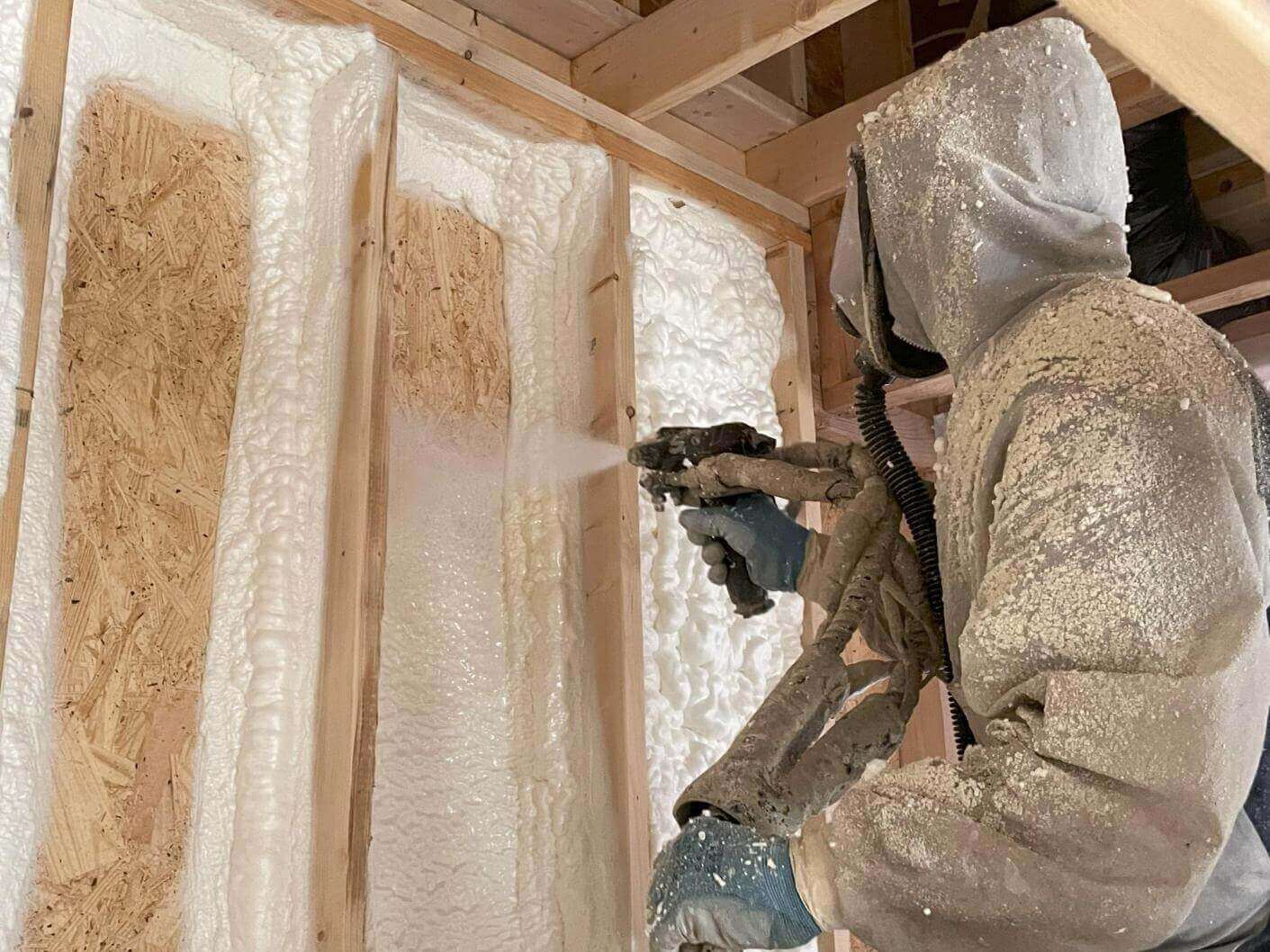
Walk into any big-box store near Fargo and you’ll find two-part spray foam kits stacked on a pallet, promising professional insulation for a fraction of the quoted price. The sticker looks like a bargain next to a contractor bid. But the number that actually matters isn’t the price of the box — it’s the price per board foot of cured, correctly-applied foam. Once you run that math for a real Fargo project, the “savings” usually shrink fast.
Short version: For a small, simple job — a rim joist, a few gaps, a section of shop wall — a DIY kit can be worth it. For anything bigger, the real cost per board foot of kit foam is often higher than a pro’s, once you account for waste, wasted kits from temperature and ratio errors, and the closed-cell R-value you lose when foam is applied too cold or too thick per pass. In Fargo’s Climate Zone 7, the two things that make foam work — a full air seal and the right thickness — are exactly what’s hardest to get right from a box. If you’re insulating a whole attic, wall, or crawl space, a professional closed-cell install almost always wins on cost and performance.
The board-foot math nobody puts on the box
Kits are sold by “board feet” — a 1-foot-by-1-foot area at 1 inch thick. A typical large two-part kit advertises around 600 board feet and sells for several hundred dollars, which pencils out to roughly a dollar-plus per board foot in theory.
The catch is that the 600 number assumes perfect yield: ideal temperature, a perfect 1:1 chemical ratio, no clogged tips, no misfires. In the real world, first-timers routinely get 60–75% of the rated yield. Off-ratio foam (too much of one side) cures brittle or stays tacky and has to be scraped out and redone. And here’s the Fargo-specific killer: these chemicals want to be applied at around 75–85°F, with the substrate warm too. Spray into a 45°F Red River Valley basement or an unheated garage in shoulder season and the foam under-expands, bonds poorly, and delivers a fraction of its rated R-value. You paid for 600 board feet and got 400 that actually perform.
Professional rigs heat both chemical components and spray at high pressure for consistent expansion and full yield — which is why a contractor’s delivered cost per board foot is often lower than a kit’s effective cost, even though the pro is also paying labor. We break the full pricing picture down in how much spray foam insulation costs in Fargo.
Where a kit genuinely makes sense
Kits aren’t a scam — they’re just a small-job tool. A DIY kit is a reasonable buy when:
- You’re sealing a rim joist or band joist in a heated basement (warm, small, high-value — see why Fargo basements lose heat at the rim joist).
- You’re filling gaps, penetrations, and a few cavities in a shop or Horace-area outbuilding you can pre-warm.
- The area is small enough to finish inside one kit’s working window — once you crack the cylinders, the clock is running.
For those jobs, the convenience is real and the stakes are low.
Where DIY quietly backfires
The trouble starts when homeowners scale a small-job tool up to a whole-house job. Three failure modes we see most around Fargo-Moorhead:
- Attics and roof decks. Getting even coverage overhead, at the right thickness, without voids is genuinely hard — and voids in an attic air barrier let warm air leak up and feed ice dams all winter.
- Too-thick passes. Closed-cell foam has to go on in ~2-inch lifts so it can cure and off-gas heat. Pile it on thick to “save time” and the interior can char or shrink — a real fire and performance issue.
- Missing the air seal entirely. Foam that looks full but has gaps behind it in a Zone 7 wall isn’t just under-performing; it can trap moisture at a cold surface. That’s the same dew-point problem we cover in spray foam, moisture, and vapor barriers in North Dakota.
None of these show up on the receipt. They show up on next winter’s heating bill — or inside the wall two years later.
The honest bottom line for a Fargo home
If your project is a weekend’s worth of rim joist or a handful of gaps in a heated space, buy the kit and enjoy it. If you’re insulating an attic, exterior walls, a crawl space, or a new build, the kit’s apparent savings usually evaporate once you factor in real yield, cold-weather losses, and the cost of redoing anything that fails an inspection or a winter. You’d be paying more for a result that’s harder to get right in the coldest corner of the lower 48.
Not sure which camp your project is in? Request a free quote — we’ll tell you honestly if it’s a job you could DIY, and give you a real per-board-foot number to compare against any kit on the shelf.