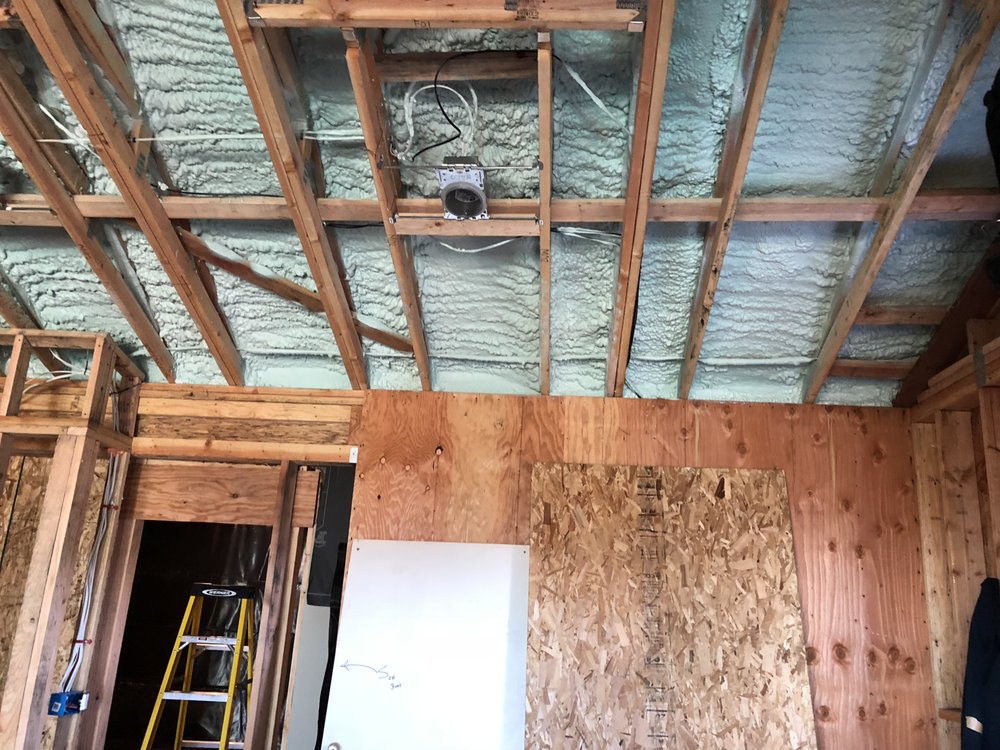
Vaulted great rooms and cathedral ceilings are everywhere in the Fargo-Moorhead metro — from newer builds to lake homes out toward Hawley. They look fantastic and they’re miserable to insulate, because there’s no attic above them: the roof rafters are the ceiling cavity, so there’s very little depth and almost no room for the ventilation a normal attic relies on. Get it wrong in North Dakota and you don’t just get a cold room — you can rot the roof sheathing from the inside.
Short version: Yes, you can spray foam a cathedral ceiling, and in North Dakota’s Climate Zone 7 closed-cell foam applied directly to the underside of the roof deck (an “unvented” or “hot roof” assembly) is usually the right answer. It air-seals and insulates in the shallow rafter space where nothing else fits, and — critically — it keeps the cold sheathing warm enough that indoor moisture can’t condense and rot it. The mistake that destroys roofs here is a half measure: too little foam, or foam plus a vent channel done wrong, which leaves a cold condensing surface right under your shingles.
Why cathedral ceilings are a cold-climate trap
A standard Fargo attic works because it’s ventilated: soffit vents let cold outdoor air wash across the underside of the roof, keeping the deck cold and dry while a thick pile of insulation sits on the flat ceiling below. A cathedral ceiling throws that away. The insulation has to live inside the rafters, inches from the roof deck, and there’s rarely enough depth for both a real vent channel and enough insulation to hit code.
Builders used to cram fiberglass batts up there and hope. In Zone 7 that fails two ways: the batts don’t come close to the R-value the shallow cavity needs, and warm, humid indoor air pushes up through them, hits the cold roof deck, and condenses. Over a few Red River Valley winters that moisture stains, molds, and eventually rots the plywood or OSB — the most expensive repair on the house.
The unvented “hot roof” — and why closed-cell is the fix
The modern cold-climate solution is to stop ventilating the assembly and seal it instead. Closed-cell spray foam sprayed directly against the underside of the roof deck does three jobs at once in a space too shallow for anything else:
- High R-per-inch (roughly R-6 to R-7) so a shallow rafter bay can still approach code.
- An air seal, so no warm indoor air ever reaches the deck to condense.
- Vapor control, because at the thicknesses used here closed-cell is its own vapor retarder.
The key detail is keeping the deck warm. Because the foam is bonded to the sheathing and the sheathing sits above the dew point, there’s no cold surface inside the assembly for moisture to collect on. That’s the same building-science logic behind flash-and-batt walls and the moisture and vapor-barrier rules for ND homes — Zone 7 punishes any assembly that leaves a cold condensing surface behind the finish.
The mistakes that rot North Dakota roofs
If you’re getting bids for a cathedral ceiling around Fargo, West Fargo, or the lakes, watch for these:
- Too little foam. A thin flash of closed-cell that doesn’t hit the required R-value leaves the deck too cold and the room underinsulated. Zone 7 needs the full thickness the rafter depth allows — spec it in inches, in writing.
- Mixing a vent channel with foam, badly. Some assemblies use a baffle plus foam, but if the detailing is wrong you get the worst of both — a cold, unsealed cavity. In a shallow cathedral rafter, a fully sealed foam assembly is almost always cleaner.
- Open-cell alone against the deck in Zone 7. Open-cell lets vapor through to the cold sheathing. It has its place, but not sprayed bare against a cold-climate roof deck without additional vapor control.
What this means for your home
If you’ve got a vaulted room that’s freezing in January, sweats or stains near the ridge, or drives your heating bill, the cathedral ceiling is very likely the culprit. Retrofitting it usually means opening the ceiling or working from above during a re-roof — which is exactly why timing it with other work pays off, the same way we describe for attic air-sealing and ice dams. It’s the same skill set as our attic insulation work, just on a sloped, sealed assembly instead of a flat attic floor.
Have a vaulted ceiling that never gets comfortable? Request a free quote and we’ll assess the rafter depth, spec the closed-cell thickness in inches for Zone 7, and lay out whether it’s a re-roof-timed job or an interior retrofit.