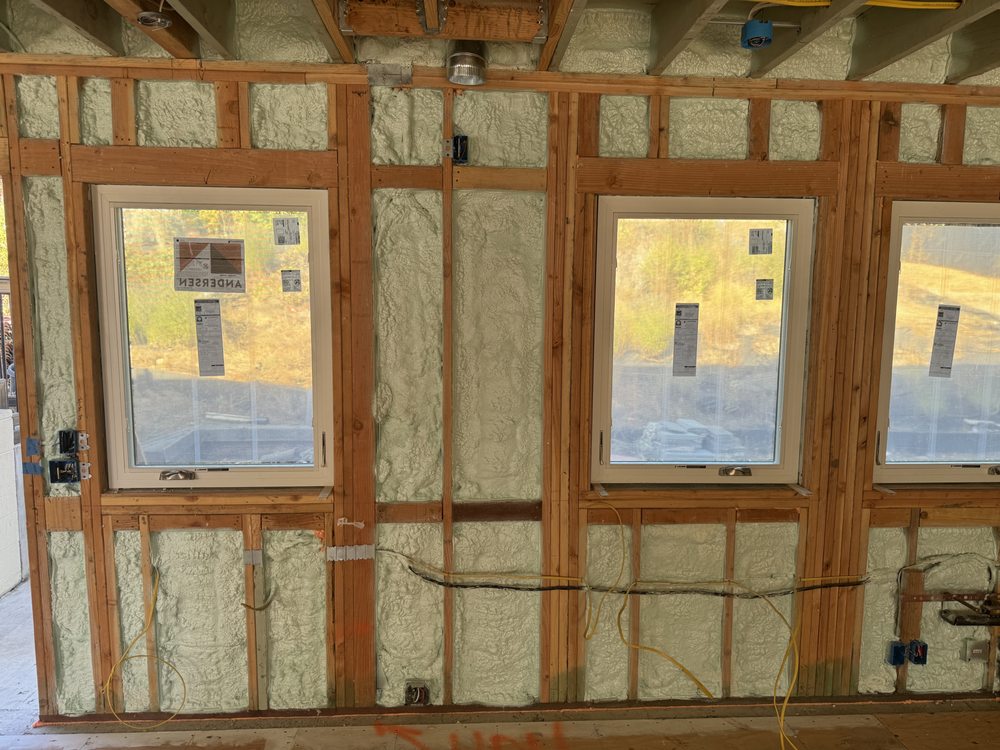
R-value gets thrown around a lot in insulation quotes, but most Fargo homeowners never get a straight answer to the question that actually matters: how much insulation does my house need to meet code, and what does that look like in spray foam? Here’s the plain-English version, written for the climate we actually live in.
Short version: Cass County and almost all of North Dakota sit in IECC Climate Zone 7 — the second-coldest in the country. For a new Fargo home, the energy code generally targets roughly R-60 in the ceiling, R-30 in above-grade walls (or R-20 + R-5 continuous), R-38 in floors, and R-15 continuous on basement walls. Closed-cell spray foam delivers about R-6.5 per inch and open-cell about R-3.7, so the right foam choice depends on how much wall or roof depth you actually have to work with.
What “R-value” really means
R-value is just a measure of how well a material resists heat flow — higher number, more resistance. But it isn’t the whole story in a North Dakota winter. A wall stuffed with R-19 fiberglass can still feel cold if air is whistling through gaps. Spray foam scores on R-value and air-sealing in one pass, which is why it punches above its rated number in a climate like ours. When you compare insulation options, look at the R-value plus how well the material stops air movement.
North Dakota sits in Climate Zone 7
The International Energy Conservation Code (IECC) divides the U.S. into climate zones based on heating and cooling demand. Cass County, Clay County, and the rest of the Red River Valley fall into Zone 7 — one step short of the Alaska-only Zone 8. North Dakota has adopted the IRC/IECC at the state level, with local jurisdictions enforcing it through the building department. Translation: when you build or substantially remodel in Fargo-Moorhead, your insulation has to clear the Zone 7 numbers, and your inspector will check.
The code R-values for a Zone 7 home
For a typical wood-framed home in our zone, the IECC targets look roughly like this:
| Assembly | R-value target (Climate Zone 7) |
|---|---|
| Ceiling / attic | R-60 |
| Wood-frame wall | R-30 — or R-20 + R-5 continuous insulation — or R-13 + R-10 continuous |
| Mass wall | R-19 |
| Floor (over unconditioned space) | R-38 |
| Basement wall | R-15 continuous (or R-19 cavity) |
| Crawl-space wall | R-15 continuous (or R-19 cavity) |
| Slab edge | R-10, 4 ft down |
Those are the prescriptive numbers from the current IECC. Builders can also hit code through a “performance path” (modeling the whole house) or with continuous exterior insulation that adds up to the same effect. Always confirm the version your jurisdiction enforces — Fargo, West Fargo, Moorhead, and the smaller cities around the metro all reference the state code but can have their own amendments.
How spray foam stacks up against those numbers
This is where the foam choice matters. Rough rule-of-thumb R-values per inch installed:
- Closed-cell spray foam: ~R-6.0 to R-7.0 per inch
- Open-cell spray foam: ~R-3.5 to R-3.8 per inch
- Fiberglass batt (for comparison): ~R-3.1 to R-3.7 per inch
- Blown cellulose (for comparison): ~R-3.2 to R-3.8 per inch
Run those against the code targets and a few things jump out for a Fargo build:
Attic (R-60): With plenty of depth above the ceiling, open-cell or a hybrid foam-and-blown-insulation approach often gets you to R-60 affordably. We handle these projects through our attic insulation service, where the air-seal at the top plates is at least as important as the R-value itself.
2x6 wall (5.5 inches of cavity): Filling the cavity with closed-cell at ~R-6.5/inch gets you roughly R-35 — clearing the R-30 cavity target with room to spare. Open-cell in the same wall lands around R-20, which works if you pair it with R-5 of continuous exterior foam. That’s the kind of decision we walk through on a wall insulation project, depending on whether you’re building new or retrofitting an older Fargo home.
2x4 wall (3.5 inches): A 2x4 cavity simply can’t hit R-30 with batts alone. Closed-cell gets you near R-22 in the cavity, then continuous exterior foam closes the gap to code. This is why older Fargo homes with 2x4 framing are great candidates for closed-cell — the foam earns its keep.
Basement wall (R-15 continuous): A couple inches of closed-cell on the foundation wall handles R-15 continuous and the moisture/vapor problem at the same time. It’s one of the highest-payback assemblies in a Red River Valley basement.
A code-passing number isn’t the whole goal
Hitting the prescriptive R-value gets your project signed off, but in a Fargo winter you’re really fighting two things: heat flow and air leakage. The IECC code numbers assume the insulation is installed cleanly and the air barrier is intact — both of which spray foam handles in a single step. A house insulated to the minimum with fiberglass and an imperfect air barrier will burn more fuel than the same house insulated to the same R-value with foam.
Want to know exactly what your home needs? Request a free quote or give us a call — we’ll walk the house, look at the assemblies you actually have, and lay out the foam thicknesses that hit (or beat) Zone 7 code without spending money where it isn’t needed.