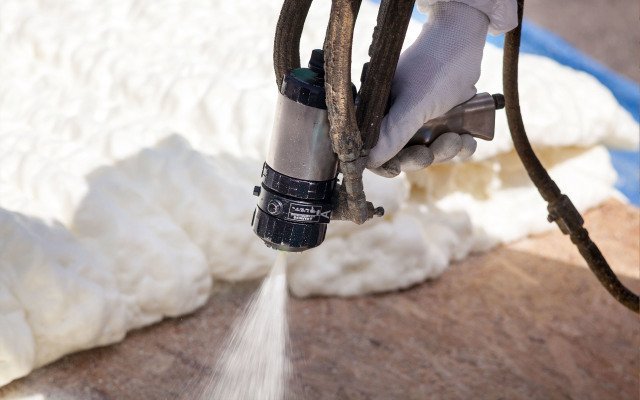
Ask ten people whether spray foam needs a vapor barrier and you’ll get ten different answers — most of them borrowed from a climate nothing like ours. In North Dakota, where a January wall can see a 90°F temperature difference between the living room and the siding, moisture physics isn’t a footnote. It’s the whole game.
Short version: In North Dakota’s Climate Zone 7, closed-cell spray foam acts as its own vapor retarder — at about 2 inches thick it qualifies as a Class II vapor retarder, so no separate poly sheet is needed over it. Open-cell foam is vapor-open and generally needs a vapor retarder on the warm (interior) side here. Get that pairing right and spray foam is one of the driest, most durable wall assemblies you can build in the Red River Valley; get it wrong and you can trap winter moisture against cold sheathing.
Why moisture is a bigger deal here than almost anywhere
Vapor drive follows warm to cold. Through a Fargo winter, warm indoor air — loaded with moisture from cooking, showers, and people — pushes constantly outward through walls and ceilings toward the -20°F outside. Wherever that vapor hits a surface below its dew point, it condenses. In a leaky, under-insulated wall, that surface is the back of your exterior sheathing, and repeated wetting is how you end up with darkened OSB, rusty nail tips in the attic, and eventually rot.
Then summer flips the direction: warm, humid Red River Valley air drives inward toward your air-conditioned interior. A North Dakota wall has to survive vapor pressure from both sides across the year — which is exactly why the old habit of stapling poly everywhere doesn’t automatically make an assembly safe.
Closed-cell foam: insulation and vapor control in one pass
Closed-cell spray foam has a closed bubble structure that water vapor can barely move through. At roughly 2 inches of thickness it performs as a Class II vapor retarder — the same class code asks for on the interior of walls in Zone 7 — while also air-sealing and insulating at about R-6 to R-7 per inch.
That’s three jobs in one material, and it’s why closed-cell is our default for the assemblies that get punished hardest by our climate:
- Rim joists, where fiberglass against cold concrete is a condensation factory — we covered this in our rim joist post.
- Crawl space and basement walls, where foam applied to concrete stays warm-side-dry.
- Exterior walls and roof decks in new construction and retrofits.
One important note: with closed-cell foam on the interior of a wall, do not add a poly sheet on top of it. The foam is already the vapor retarder; doubling up creates a second condensing surface and can trap moisture between layers.
Open-cell foam: great insulator, needs a vapor strategy
Open-cell spray foam air-seals just as well as closed-cell — which matters, because air leakage moves far more moisture than diffusion ever does — but its open structure lets vapor pass through. In a mild climate that’s fine. In Zone 7, open-cell against a cold roof deck or exterior wall can let winter vapor migrate through the foam and condense on the cold surface behind it.
The fix is simple and code-recognized: pair open-cell with a Class II vapor retarder on the interior side — typically a vapor-retarder primer painted on the drywall, or a smart membrane. Used that way, open-cell remains an excellent, budget-friendly choice for interior walls, sound dampening, and attic floors in Fargo-area homes.
The mistake we see most in older Fargo homes
Retrofits in older neighborhoods — the pre-war housing stock in Fargo and the older blocks of Moorhead — often already have poly or foil-faced batts in some walls. Spraying foam without accounting for what’s already in the assembly is how “moisture sandwich” problems start: two vapor-tight layers with wet-able material trapped between them. A proper install starts with knowing what’s in the wall, not just filling the cavity. It’s one more reason the cheap-and-fast approach (or a DIY kit) costs more in the long run.
What this means for your project
- Rim joists, basements, crawl spaces, exterior walls, roof decks: closed-cell, 2+ inches, no added poly.
- Interior walls, sound control, budget attic work: open-cell plus an interior vapor retarder where the assembly faces the cold.
- Older home retrofit: have someone open up and check the existing layers first.
Moisture-safe insulation isn’t about one magic product — it’s about matching the foam type and vapor strategy to North Dakota’s climate. That’s the difference between an assembly that stays dry for 80 years and one that quietly rots.
Planning insulation and want it done moisture-right? Request a free quote or call — we’ll look at your actual assembly and spec the foam and vapor approach that fits Zone 7, not a generic answer off the internet.