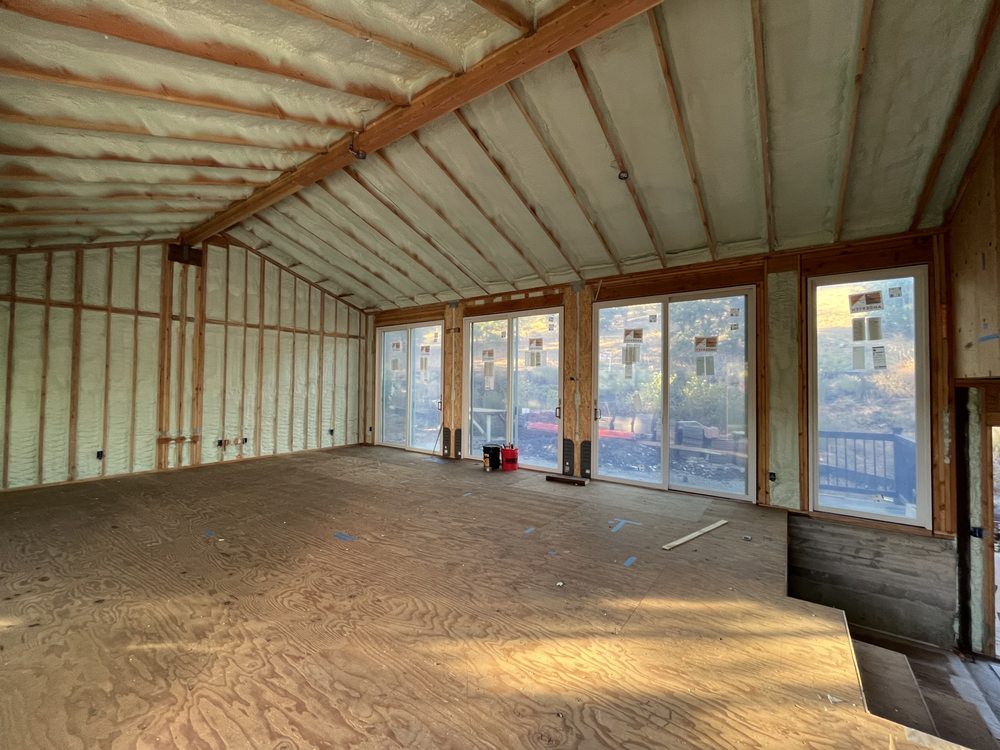
A pole barn or steel shop is a different animal from a house. Out here in the Red River Valley, the temperature swings are bigger, the building skin is thinner, and the humidity inside often comes from things a house never sees — running engines, washing equipment, hot welds, even animals. That’s why so many shops in Cass, Clay, and Richland counties have the same three problems: cold floors in January, dripping ceilings in March, and a propane bill that nobody can explain. The good news is that one well-planned spray foam job usually fixes all three.
Short version: For a metal pole barn or shop in North Dakota, closed-cell spray foam sprayed directly on the underside of the steel is almost always the right answer. It hits Climate Zone 7 R-values, eliminates the condensation drip you get when warm indoor air meets a cold steel roof, and air-seals the seams that batts and bubble wrap can’t. A typical 40’ x 60’ shop in the Red River Valley needs roughly R-49 in the ceiling and R-21+ in the walls to be comfortable to work in year-round.
Why Red River Valley pole barns are condensation factories
Most pole barns around Fargo, West Fargo, Horace, Casselton, Mapleton, and across the river in Moorhead and Dilworth are framed with wood posts and skinned with corrugated steel. In a Zone 7 winter the steel hits temperatures well below the dew point of the air inside, and any warm moist air that touches it gives up its water. That’s the drip you find on the floor under your tractor in February, or the rusty streak running down the inside of the wall sheets after a thaw.
Fiberglass batts and reflective bubble-wrap “insulation” don’t solve this — they trap that moist air against the steel and accelerate the corrosion. Closed-cell spray foam, sprayed directly to the inside of the steel, bonds to the panel, eliminates the air gap, and stops the dew point from being inside the assembly in the first place. No air contact, no condensation, no rust.
The Climate Zone 7 targets for an ag/shop building
The IECC numbers for unheated agricultural buildings are loose, but the moment you put a furnace or radiant floor in a shop you’re functionally heating a building, and Zone 7 numbers start to matter. Realistic targets for a heated Red River Valley shop:
- Roof / ceiling: R-49 to R-60, depending on whether the ceiling is flat or following the roofline.
- Walls (above the wainscot): R-21 to R-30 — usually 3–4 inches of closed-cell foam between the girts.
- Slab edge / perimeter: R-10 of rigid or closed-cell foam, at least 4 ft down or under the slab.
- Overhead doors: an insulated door (R-12+ at minimum) — the door is almost always the weakest link.
Hobby shops and heated machine sheds that hit those numbers can usually be held at 55–60°F all winter on a fraction of the propane an uninsulated metal building burns.
Open-cell vs. closed-cell in a metal building
We covered the residential version of this in Open-Cell vs. Closed-Cell Spray Foam. For pole barns the answer is more clear-cut than it is in a house:
- Closed-cell (~R-6.5 per inch) is the default for the underside of steel roofs and walls. It’s a vapor retarder at 1.5–2 inches, it stiffens the steel panels noticeably, and it doesn’t absorb moisture if something leaks.
- Open-cell (~R-3.7 per inch) can make sense on interior partition walls or between living quarters and a shop bay for sound, but on the cold side of a Red River Valley building it lets too much vapor through for our climate.
If you’re insulating a finished shop with living quarters — a so-called “barndominium” — we usually pair closed-cell on the exterior assemblies with open-cell on the interior walls.
Real-world projects we see around Fargo-Moorhead
A handful of patterns we run into constantly on commercial and ag spray foam jobs across the metro:
- Hobby and woodworking shops in West Fargo and Horace — owners want to run a heater off-grid for a weekend without losing all the warmth overnight. Closed-cell roof + walls is the move.
- Machine and equipment storage out by Casselton and Mapleton — the goal isn’t comfort, it’s keeping equipment dry and rust-free. Even a 2-inch flash of closed-cell on the underside of the roof eliminates the worst of the condensation.
- Heated farm shops — a real working shop with welders, lifts, and parts washers needs the full Zone 7 envelope: full-depth foam in the roof, foam between the wall girts, an insulated overhead door, and slab-edge insulation if it isn’t already there.
- Pole barn living quarters / shouses in Moorhead and Dilworth — these have to pass the same residential energy code as a house, and spray foam is usually the easiest way to hit Zone 7 numbers in a thin-walled building.
A few Red River Valley specifics worth knowing
- Wind washing. Our prevailing winter winds out of the northwest can drive cold air through a vented soffit and “wash” the warmth right out of loose-fill or batt insulation in the ceiling. Spray foam doesn’t wash.
- Snow load and roof movement. Steel roofs flex under heavy spring snow. Closed-cell foam moves with them; rigid board insulation tends to crack at the fasteners.
- Heated slabs. If you’re pouring (or already have) a heated slab, the perimeter insulation matters more than the slab itself. Cold leaks out the edges into our frost-zone soil.
- Ag and energy rebates. Some local cooperatives — including Cass County Electric — periodically offer rebates on insulation upgrades for member-owned ag buildings. Ask before you start; the paperwork is easier to handle up front.
What to do next
If you’re sketching out a new shop, retrofitting a pole barn that’s been miserable for years, or finally tired of the rust streaks on the inside walls, that’s exactly the kind of project we’re built for. Request a free quote or give us a call — we’ll walk the building with you, measure the existing assembly, and lay out a foam plan that gets the Red River Valley out of your shop for good.