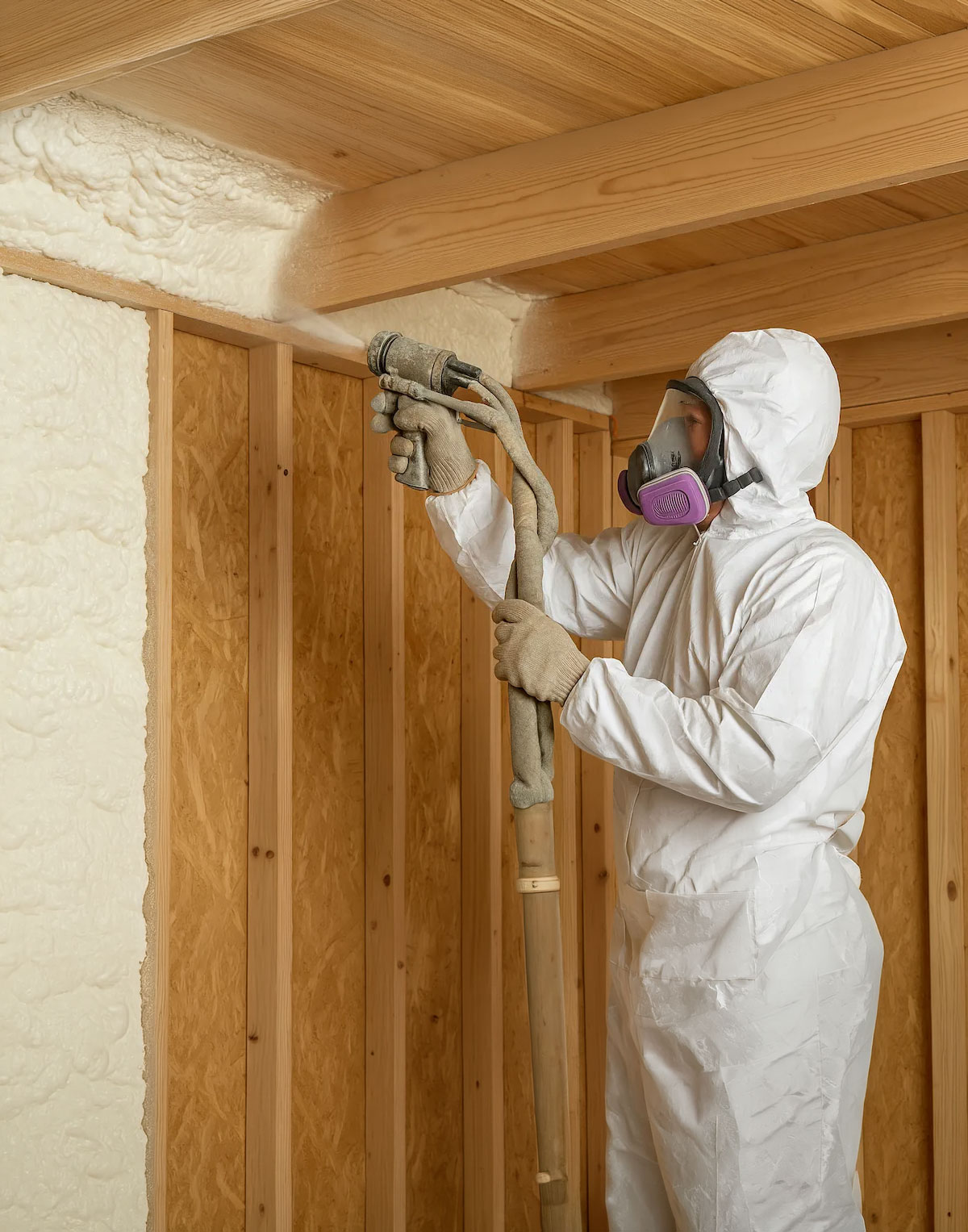
If you’ve started pricing out spray foam, you’ve run into the first real decision: open-cell or closed-cell? They look similar going on the wall, but they behave differently — and in a climate as demanding as North Dakota’s, the difference matters. Here’s how to think about it without the sales pitch.
Short version: Closed-cell foam has a higher R-value per inch and blocks moisture, which makes it the safer default for North Dakota’s cold, humid swings — especially in crawl spaces, rim joists, and exterior walls. Open-cell is cheaper and great for interior walls, attics, and sound dampening where moisture isn’t the main concern. Many Fargo homes use a mix of both.
The quick comparison
| Open-cell | Closed-cell | |
|---|---|---|
| R-value per inch | ~3.5–3.8 | ~6.0–7.0 |
| Moisture / vapor | Permeable (lets moisture through) | Resists water; acts as a vapor retarder at depth |
| Density | Light, spongy | Dense, rigid |
| Adds structural rigidity | No | Yes |
| Relative cost | Lower | Higher |
| Best for | Interior walls, attics, soundproofing | Crawl spaces, rim joists, exterior walls, anywhere moisture is a risk |
Why closed-cell is the cold-climate workhorse
North Dakota sits in one of the coldest climate zones in the country, and our winters pair deep cold with big temperature swings against warm indoor air. That combination drives moisture toward — and sometimes into — your walls and rim joists, where it can condense and cause problems over time.
Closed-cell spray foam handles this in two ways. Its higher R-value (roughly 6–7 per inch) means you get more insulation in less space, which is a real advantage in a 2x4 or 2x6 wall cavity. And because it’s dense and effectively water-resistant at the thicknesses we install, it doubles as a vapor retarder — so it both insulates and protects the assembly. That’s why we lean on it for crawl spaces, rim joists, and exterior walls in homes across the Fargo-Moorhead area, from West Fargo to Moorhead.
Where open-cell earns its place
Open-cell foam isn’t a lesser product — it’s a different tool. It’s lighter, expands more, and costs less per square foot. For interior partition walls, sound dampening, and many attic applications where it’s protected from bulk water, open-cell does the job at a friendlier price. Its lower R-value per inch matters less in an attic where there’s plenty of room to build up depth.
So which should you get?
It comes down to where the foam is going and what it has to resist:
- Crawl space, rim joist, or exterior wall? Closed-cell, almost always — moisture resistance and R-value both count there.
- Interior wall, soundproofing, or open attic? Open-cell is usually the cost-effective choice.
- Whole home? Most likely a mix — closed-cell where moisture and tight cavities demand it, open-cell where you just need R-value and quiet.
The honest answer is that the right call depends on your specific home — its age, where the cold is getting in, and what you’re trying to fix. That’s exactly what an on-site assessment is for.
Not sure which one your project needs? Request a free quote or give us a call — we’ll walk your home, point to where the heat is actually leaking, and recommend the right foam for each spot.